THE OLD TOWN IN ONE LOOP
Ten stops, one way round
- Royal Palace
From the palace, walk to the top of Storkyrkobrinken and turn onto Trångsund, where the cathedral stands.
- Storkyrkan
Trångsund runs on from the cathedral into the square.
- Stortorget
Leave the square on Kåkbrinken and follow it to Prästgatan.
- Prästgatan
Walk south along Prästgatan and turn onto Tyska Brinken for the German Church.
- Tyska Kyrkan
Back on Prästgatan, keep heading south to the top of the alley.
- Mårten Trotzigs Gränd
Take the steps down to Västerlånggatan and Järntorget.
- Järntorget
Walk north on Österlånggatan and climb Köpmanbrinken to the little square.
- Köpmantorget
Follow Köpmangatan toward Stortorget, then make for the Finnish Church beside the palace.
- Järnpojke
Walk down Storkyrkobrinken to Riddarhustorget and cross Riddarholmsbron.
The order of the guide’s sections. The ring is not a map: it shows sequence, not distance or position.
01 / THE STOCKHOLM GUIDE
The Royal Palace (Kungliga Slottet)
The Royal Palace fills the northern end of Gamla Stan, between Skeppsbron and Slottsbacken: on a short visit its ramps and courtyards are enough, and if you go inside, pick the Treasury and the Tre Kronor Museum. Its outer walls, ramps and courtyards frame every approach to the old town.
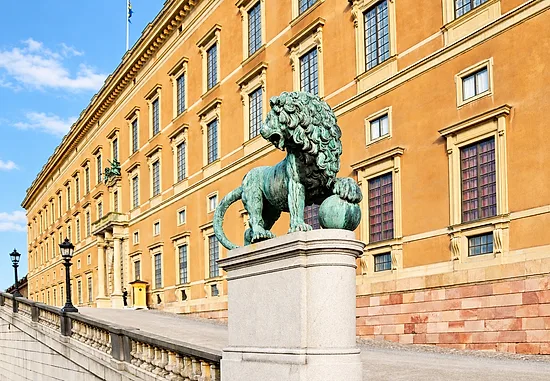
Key Exterior Architectural Markers
- Roman Baroque Facade The sandstone and brick exterior shows strong Italian and French Baroque influence. The palace replaced the medieval castle that stood here until it was destroyed by fire.
- Lejonbacken Ramps The northern approach climbs up twin stone ramps guarded by a pair of bronze lions.
- The Outer Courtyard (Yttre borggården) A semicircular courtyard opening off the west side of the palace.
Interior Sights Evaluation
Palace Wing / Museum
The State Apartments
- What You See Inside
- The Hall of State (Rikssalen) with Queen Christina’s silver throne, alongside the Bernadotte reception suites and guest chambers.
- Visitor Value
- High for interior design, decorative arts, and royal ceremonial history.
Palace Wing / Museum
The Treasury (Skattkammaren)
- What You See Inside
- Dimly lit subterranean cellars safeguarding Sweden's sovereign regalia, including Gustav Vasa’s state sword and Erik XIV’s crown.
- Visitor Value
- Essential for concise, high-impact historical viewing without large tour crowds.
Palace Wing / Museum
Tre Kronor Museum
- What You See Inside
- Remains of the foundations, vaults and defensive walls of the old fortress that burned down.
- Visitor Value
- High for medieval archaeology enthusiasts; skips the gilded decor in favor of raw masonry.
Inside vs. Outside Verdict
OUTSIDE
Stick to the Outside if
Your visit to the old town is a short one. Walking the Lejonbacken ramps, crossing the inner courtyard and taking in the harbor views from Slottsbacken give you the palace’s architectural weight without using up your time.
INSIDE
Go Inside if
You have half a day and want to see royal artifacts. If you choose only one interior, pick the Treasury vaults and the Tre Kronor Museum over the sprawling State Apartments for the most distinct history.
02 / THE STOCKHOLM GUIDE
Storkyrkan (Stockholm Cathedral)
Storkyrkan (the Church of Saint Nicholas), on Trångsund steps from the Royal Palace, is worth stepping inside for its medieval interior behind a Baroque exterior.
Exterior Architecture: The Baroque Disguise
The Baroque Disguise
From the outside, Storkyrkan looks entirely Baroque. Its exterior was remodeled with ochre plaster and classical details so that it would sit comfortably beside the Royal Palace next door. Do not let the plain facade fool you: the older church is still there behind the plaster.
Key Interior Highlights
- Saint George and the Dragon (Sankt Göran och draken)
- Vädersolstavlan (The Sun Dog Painting)
- The Silver Altar
- Royal Pews (Kungsbänkarna)
Key Interior Highlights
Stepping inside reveals exposed red-brick Gothic vaulting and some of the city’s most significant historical pieces:
- Saint George and the Dragon (Sankt Göran och draken) A monumental late-medieval carving made to commemorate the Battle of Brunkeberg, carved from oak and decorated with real elk antlers.
- Vädersolstavlan (The Sun Dog Painting) A faithful copy of a lost original, and the oldest known color depiction of Stockholm, showing a striking halo phenomenon in the sky over the medieval town.
- The Silver Altar An imposing High Baroque centerpiece constructed from solid ebony and embossed silver, framed by dramatic central nave arches.
- Royal Pews (Kungsbänkarna) Ornate, enclosed wooden royal boxes used for state ceremonies and royal weddings.
Inside Verdict: Worth Stepping In
Why The interior holds genuine late-medieval pieces and Gothic brickwork you will not see anywhere else in the historic center. If you step inside only one church in the old town, make it this one.
03 / THE STOCKHOLM GUIDE
Stortorget: The Old Town’s Main Square
Stortorget is the oldest public square in Stockholm and the heart of Gamla Stan, known for its step-gabled 17th-century merchant houses and as the site of the 1520 Stockholm Bloodbath.
NORTH SIDE
Börshuset and the Nobel Prize Museum
WEST SIDE
Schantzska Huset (No. 20) · Seyfridtzska Huset (No. 22)
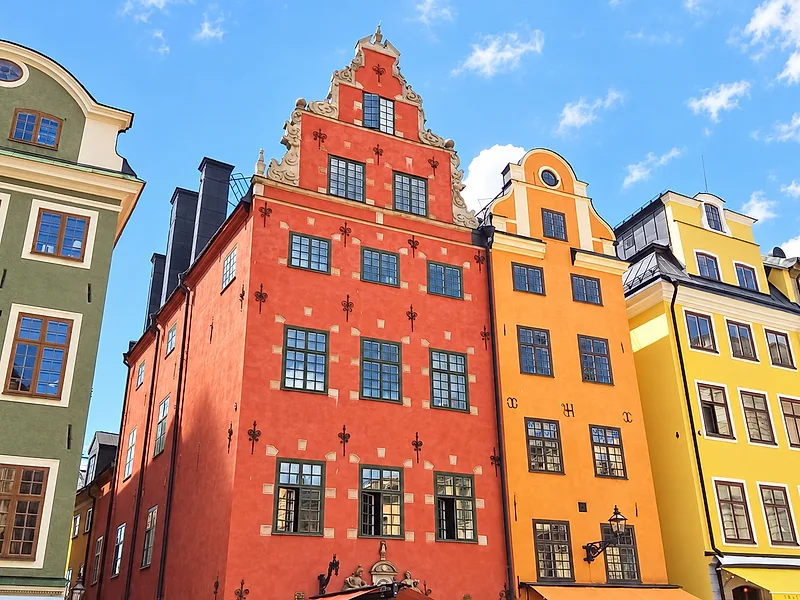
Western Perimeter: Gabled 17th-Century Townhouses
The postcard view of Stortorget rests on its western facade:
- Schantzska Huset (No. 20) The deep red, step-gabled house. Legend says each white stone set into its facade stands for one of the people executed in the 1520 Stockholm Bloodbath; the number of stones and victims is told differently from source to source.
- Seyfridtzska Huset (No. 22) The ochre-yellow townhouse next door, with a curved Baroque gable and an ornate portal.
The Historic Cannonball at Skomakargatan
At the corner where Skomakargatan meets Stortorget, look up at the corner wall above street level:
- The Artifact An iron cannonball remains lodged directly into the masonry.
- The History Lore ties it to Gustav Vasa’s siege of Stockholm against Christian II, but it was set into the wall later, when the house was rebuilt, as a reminder of that siege.
Börshuset and the Nobel Prize Museum
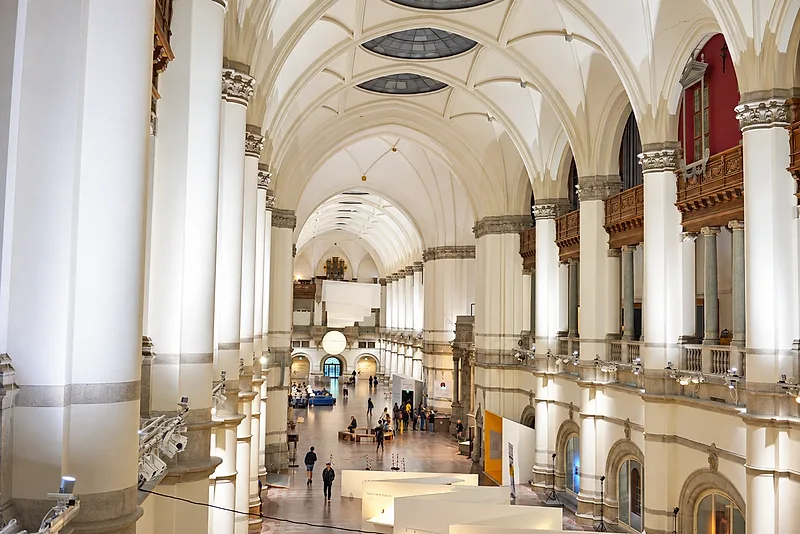
The northern edge of Stortorget is dominated by Börshuset, the Old Stock Exchange Building. Today it houses the Swedish Academy and the Nobel Prize Museum.
Nobel Prize Museum Inside Evaluation
- What you see Rotating exhibits on Nobel laureates, scientific breakthroughs, the legacy of Alfred Nobel, and signed chair undersides in the museum bistro.
- Visitor verdict Skip if on a tight schedule. The exhibits are well-curated, but for short itineraries focused on Gamla Stan's historic fabric, prioritizing the square's exterior architecture and the surrounding medieval alleyways offers far better value. If the weather turns poor or you have a dedicated interest in 20th-century science and literature, it serves as a solid indoor stop.
04 / THE STOCKHOLM GUIDE
Prästgatan: A Quiet Lane and a Runestone
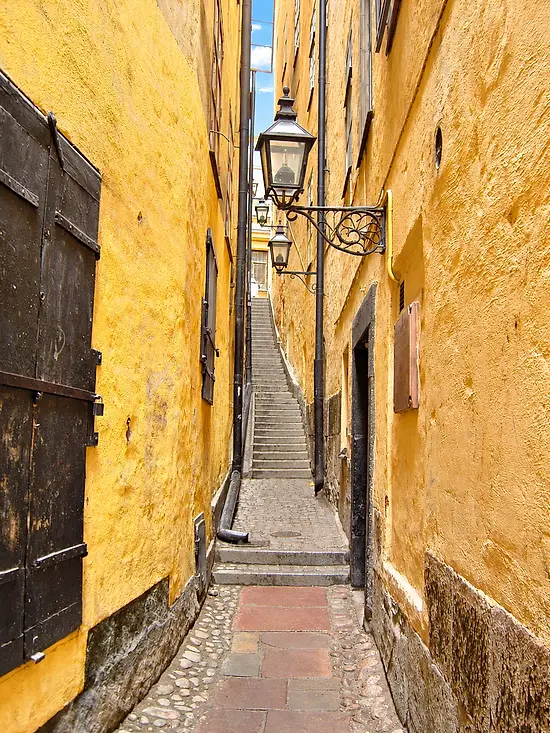
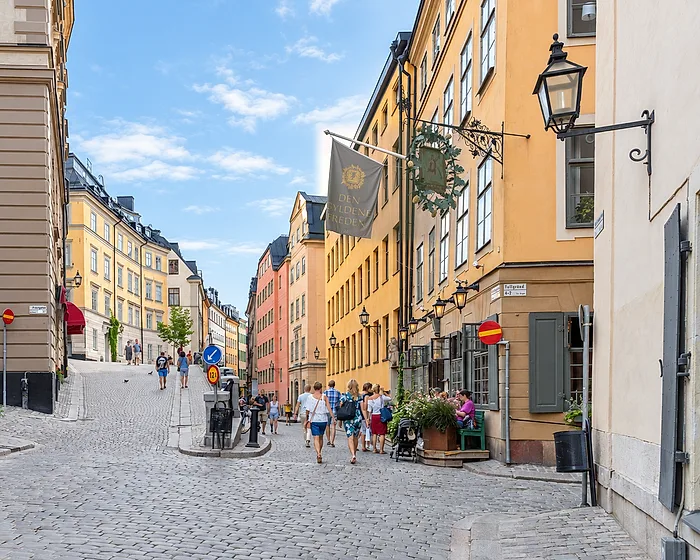
Prästgatan, one block east of Västerlånggatan, is the quiet alternative to the souvenir shops: a cobbled lane along the line of the 13th-century wall, with a Viking-age runestone built into the corner at Kåkbrinken. With few shops along it, it is one of the best places in Gamla Stan for medieval atmosphere.
Key Architectural Markers and Sights on Prästgatan
LOOK DOWN
The Viking-Age Runestone (U 53) At the corner of Prästgatan and Kåkbrinken, look down at the base of the building. A carved runestone with a serpent band is built into the corner masonry. Above it sits an old iron cannon barrel, mounted there to keep cart wheels from damaging the wall.LOOK UP
Wrought-Iron Wall Anchors (Ankarslut) Scan the upper facades between the second- and third-floor windows. You will see dark, visible iron rods shaped into crosses, figure-eights, and 'X' patterns. These structural anchors tied the interior wooden floor beams directly to the exterior brick walls to keep the tall, narrow townhouses from bowing outward.LOOK ALONG
Intact Medieval Curves Because the lane follows the curve of the old fortification line, building facades bend gently, creating continuous vanishing points with warm ochre, rust-red, and pale gold plaster finishes.
Atmospheric Exterior Stroll Highlights
- Walking Strategy Walk the lane from the Storkyrkobrinken end, and glance down the steep side alleys that drop toward Lake Mälaren as you go.
05 / THE STOCKHOLM GUIDE
Tyska Kyrkan (The German Church)
Tyska Kyrkan (St. Gertrude’s) is the church of the Hanseatic merchants who shaped medieval Stockholm; outside, its spire and sandstone portals are the details to look for.
Spotting the Spire and Sandstone Portals
- The Svartmangatan Sightline The copper-clad neo-Gothic spire, the tallest in the old town, dominates the southern skyline. The best street-level view is from the narrow corridor of Svartmangatan.
- Carved Entrances The southern and western sandstone portals feature gilded German inscriptions—including "Fürchtet Gott! Ehret den König!" (Fear God! Honor the King!)—flanked by sculpted patron figures.
Interior Highlights
Inside, the space functions as a preserved 17th-century German merchant sanctuary:
- The Baroque Altar A towering High-Baroque altarpiece commands the choir.
- Kungsbänken (The King's Gallery) A lavishly carved, enclosed gallery box suspended above the nave floor, built specifically to seat royal guests during services.
- Stained Glass Panels The large southern windows filter colored light across the brick vaults.
Inside Entry Evaluation
Casual walkers
The view from Svartmangatan and a quick look at the sandstone portals give you enough context without slowing your walk.
Architecture and history enthusiasts
Step inside. The craftsmanship of the King’s Gallery and the Baroque altar make it one of the most richly decorated interiors in the old town.
06 / THE STOCKHOLM GUIDE
Mårten Trotzigs Gränd: Stockholm’s Narrowest Alley
Mårten Trotzigs Gränd is a steep flight of stone steps between Prästgatan and Västerlånggatan that narrows to little more than shoulder width; walk it downhill, early or late in the day, to avoid the tour groups. It is named after the merchant Mårten Trotzig.
The Pinch Point
Navigating this corridor takes you through a unique architectural pinch point:
- Dimensions A steep flight of stone steps that narrows to little more than shoulder width at its tightest point.
- Spatial feel At the center, you can easily touch the weathered stone facades on both sides simultaneously with your elbows out.
Medieval Masonry and Vertical Perspectives
The alleyway provides one of the best raw architectural perspectives in the Old Town:
- Extreme vertical angles Looking upward from the midpoint frames a razor-thin strip of sky between towering, ochre-washed medieval walls.
- Surface textures The walls showcase layered centuries of uneven plaster, exposed brickwork, and wrought-iron structural reinforcements.
- Lighting Early-morning or late-day light creates strong shadow contrasts for photography.
Tactical Route: Downhill from Prästgatan
Because Mårten Trotzigs Gränd is a prime attraction on any Gamla Stan walking route, it frequently bottlenecks with tour groups.
- Walk downhill Enter from the quiet cobblestones of Prästgatan and walk down toward Västerlånggatan. This gives you full visibility of oncoming foot traffic and saves you an uphill climb.
- Beat the crowd Come early in the morning or in the evening, when the passage is quieter and you can take a clear photograph.
07 / THE STOCKHOLM GUIDE
Järntorget and Södra Bankohuset: The Iron Square
Järntorget, at the southern tip of Gamla Stan, was the square where Sweden’s iron exports from the Bergslagen mines were weighed.
The Legacy of Södra Bankohuset
- World Banking History This monumental building served as the headquarters for Sveriges Riksbank, the oldest central bank in the world.
- Architectural Style The structure features a strictly ordered Roman Renaissance and early Baroque facade, marked by heavy rusticated sandstone on the ground floor to reflect institutional power and security.
Commerce Markers and Architectural Details to Spot
To read the maritime trade history etched into the square, look for these markers:
08 / THE STOCKHOLM GUIDE
Österlånggatan and Köpmantorget
The eastern side of Gamla Stan is quieter: walk from Österlånggatan up to Köpmantorget for some of the best-preserved merchant architecture in the old town.
UP FROM ÖSTERLÅNGGATAN
Relative heights only. The guide describes the climb up the steps of Köpmanbrinken; it gives no heights.
Strolling Österlånggatan's Bourgeois Architecture
While Västerlånggatan is full of souvenir shops, Österlånggatan keeps more of its historic character. It runs along the eastern side of the island, lined with former merchants’ houses.
- Old Facades Notice the warm ochre, rust and terracotta plaster finishes.
- Vaulted Portals Look above doorways for carved sandstone cartouches and merchant coat-of-arms reliefs marking old trade residences.
- Vaulted Archways The narrow passages branching off to the west cut through old brick arches that supported expanding upper-floor residences centuries ago.
Köpmantorget and the Saint George Monument
Climbing the short stone steps of Köpmanbrinken brings you up into Köpmantorget (The Merchant’s Square), a quiet raised square.
- The Saint George and the Dragon Monument The centerpiece of the square is a bronze copy of the Saint George and the Dragon carving inside Storkyrkan.
- Viewing Angle Because the statue sits elevated on a granite plinth, you can inspect the intricate details of the dragon, the horse armor, and the Princess of Cappadocia from all angles in natural daylight—something that is difficult inside the dimly lit cathedral.
Köpmangatan: Back Toward Stortorget
Leading directly west out of Köpmantorget back toward Stortorget is Köpmangatan (The Merchant's Street).
- Architectural Detail Watch for low, vaulted basement entries and deep-set ground-floor windows, marking former merchant storage cellars that sit below modern street level.
09 / THE STOCKHOLM GUIDE
Bollhustäppan and the Iron Boy
Bollhustäppan, a quiet courtyard behind the Finnish Church (Finska kyrkan) across from the Royal Palace’s southern facade, is where you find Järnpojke, the Iron Boy, often called the smallest public statue in Stockholm. You reach it through an iron gate off Slottsbacken.
The Boy Looking at the Moon
Sitting on a low plinth inside the courtyard is Järnpojke, the “Little Boy Looking at the Moon”.
- Form The small iron figure shows a boy sitting curled up, hugging his knees and looking up toward the sky.
Cultural Customs and Practical Photo Tips
Visiting the sculpture is one of the most unique things to do in Gamla Stan, driven largely by local tradition and folklore.
- Offerings and Traditions Locals and travelers routinely leave small coins on the plinth for good luck or rub the boy's head to ensure a return trip to Stockholm. In winter, neighborhood residents knit tiny wool caps and scarves to keep the figure dressed against the cold.
- Photography Angle Get your camera down to ground level right beside the plinth. Shooting upward captures the contrast between the miniature iron figure and the towering medieval brick facades surrounding the courtyard.
- Timing Visit early in the morning before tour groups crowd the tiny courtyard, allowing for clear photos without waiting in line.
10 / THE STOCKHOLM GUIDE
Riddarholmen and Riddarholmskyrkan
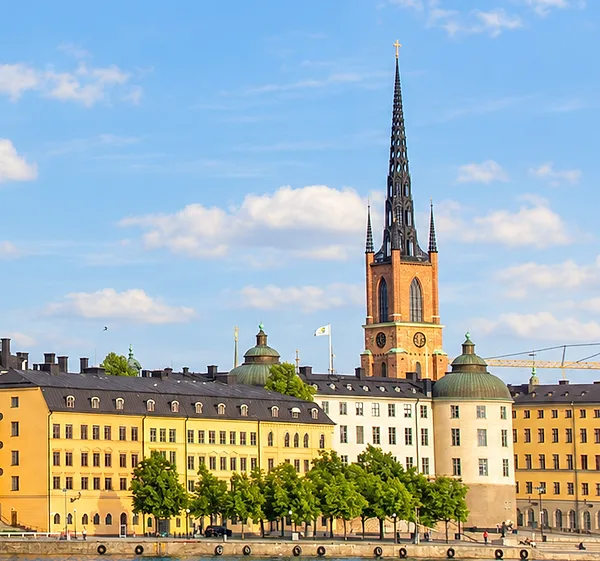
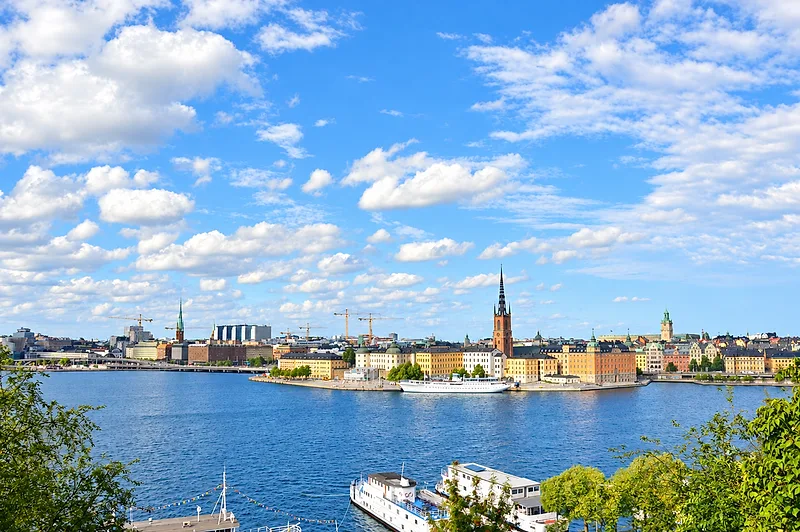
Riddarholmen, across Riddarholmsbron from the western edge of Gamla Stan, is a quiet islet of aristocratic palaces now used by the courts, with Riddarholmskyrkan, the royal burial church, and a wide view over Lake Mälaren from Evert Taubes Terrass.
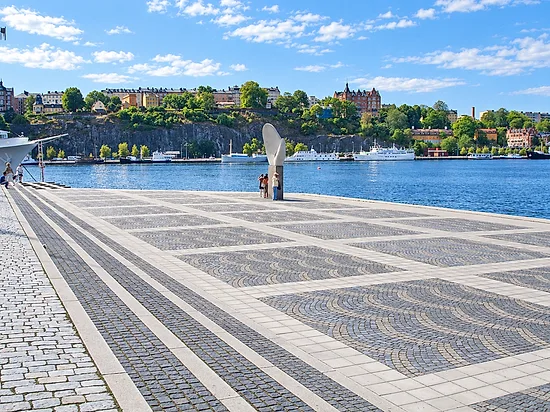
Landmark Architecture on Birger Jarls Torg
Riddarholmen served as the power center for Sweden's 17th-century nobility. The quiet central square, Birger Jarls Torg, contains remarkably intact imperial architecture:
- Riddarholmskyrkan Stockholm’s only preserved medieval abbey church, recognizable across the water by its cast-iron openwork spire.
- Wrangel Palace (Wrangelska Palatset) A grand 17th-century palace that became the royal residence after the old Tre Kronor castle burned down.
- Stenbock Palace and Hessenstein Palace Grand aristocratic houses that are now used by the courts.
- Evert Taubes Terrass The open terrace on the western quay, with a wide view over Lake Mälaren toward Stockholm City Hall (Stadshuset).
Inside Riddarholmskyrkan: Entry Verdict
Unlike standard parish churches, Riddarholmskyrkan operates exclusively as a royal burial site and museum.
- Key Highlights The church holds the tombs of Swedish monarchs from the Middle Ages onward, and its walls are lined with painted coats of arms of Knights of the Royal Order of the Seraphim.
Verdict Go in if it is open when you visit and you care about Swedish royal history, royal tombs and medieval brick architecture. If it is closed, walk the edge of the island for the architecture and the waterfront views.
11 / THE STOCKHOLM GUIDE
Walking Gamla Stan: Shoes, Timing and Finding Your Way
Wear shoes made for cobblestones, walk early or late to avoid the crowds, and use the church spires to find your way.
Footwear and Terrain Realities
- Cobblestones (kullersten) Almost every street is paved with rounded cobblestones that are uneven, and slippery when wet or icy.
- Steep Stairways Connecting passages between higher ridges (like Prästgatan) and lower commercial streets feature steep, worn stone stairs.
- Footwear Choice Skip heels, thin flat soles, and slick leather shoes. Wear supportive walking shoes or boots with thick, high-traction rubber soles to absorb impact and prevent ankle rolls.
Best Times to Walk Gamla Stan
- Early Morning The best window for photography. The lanes are at their quietest and the low light picks out the facades along Prästgatan and Stortorget.
- Midday Tour groups and cruise visitors gather along Västerlånggatan and around the Royal Palace courtyards. Use this time to step inside a church or museum, or head out to Riddarholmen.
- Late Evening Street lamps cast long shadows along the narrow lanes, the most atmospheric time for a quiet walk on your own.
Navigation by Church Spires
Use the church spires on the skyline to find your way between the Baltic side (east) and Lake Mälaren (west):
FIND YOUR WAY BY THE SKYLINE
south
Tyska Kyrkan (German Church) The tallest spire in the old town rises from its southern half. If it is ahead of you, you are heading south.north
Storkyrkan The square brick tower marks the high northern ridge right next to the Royal Palace.west
Riddarholmskyrkan The distinct cast-iron lattice spire marks the western flank over the bridge toward Lake Mälaren.
Directions as the guide gives them for each spire. Not to scale.
12 / THE STOCKHOLM GUIDE
Frequently Asked Questions About Gamla Stan
How long does it take to walk through Gamla Stan?
Walking straight across the island is quick. Exploring the historic core properly takes longer:
- Quick highlights loop A short loop covers the main streets, Stortorget, Mårten Trotzigs Gränd and the palace courtyards.
- In-depth exploration with interiors Allow half a day to step inside Storkyrkan or the Royal Palace, browse side streets like Prästgatan and cross over to Riddarholmen.
Is Gamla Stan safe to walk around at night?
The main streets stay busy with diners and people walking into the evening, and the lanes are lit. Take the usual care you would in any city center.
- The hazard most visitors notice after dark is the uneven paving and slick stone steps.
Which attractions in Gamla Stan are worth going inside?
Most of the old town’s charm is free to see from the street. If you only step inside a few places, choose these:
Go in
- Storkyrkan (Stockholm Cathedral) The best interior to pick. The carved Saint George and the Dragon and the Vädersolstavlan painting make it worth going in.
If it interests you
- The Royal Palace (Kungliga Slottet) Worth going inside if you want to see the crown regalia in the Treasury (Skattkammaren) and the State Apartments.
- Riddarholmskyrkan For history enthusiasts, if it is open when you visit: the resting places of Swedish monarchs and the heraldic shields of the Order of the Seraphim.
Lower priority
- Skip/Lower Priority The Nobel Prize Museum, unless you have a specific interest in it.
Can you explore Gamla Stan easily without a guided tour?
Yes. Gamla Stan is compact enough to find your way around on your own.
- You can plan a straightforward self-guided walking route by following key parallel streets (Västerlånggatan, Prästgatan, and Österlånggatan).
- Prominent vertical landmarks like the copper spire of Tyska Kyrkan and the tower of Storkyrkan provide immediate visual orientation wherever you wander between Lake Mälaren and the Baltic Sea.
13 / FURTHER READING
Related Sources
BEFORE YOU GO
A flexible plan is a better plan.
Opening hours, admission policies, services and access can change. Check each attraction’s official website and the SL journey planner before travelling. Suggested times in this guide are planning estimates, not venue opening hours or guaranteed transfer times.
Last verified .
PHOTOGRAPHS & LICENCES4
- Gamla stan 2018 DSC00931 03.jpg — Øyvind Holmstad · CC BY-SA 4.0, via Wikimedia Commons. Brightened and colour-adjusted for this page; cropped to fit. The edited version is shared under the same licence.
- Sweden 0682 (4022975841).jpg — Dennis G. Jarvis · CC BY-SA 2.0, via Wikimedia Commons. Brightened and colour-adjusted for this page; cropped to fit. The edited version is shared under the same licence.
- Estocolmo julio-2025 2.jpg — Gbeltranp · CC BY 4.0, via Wikimedia Commons. Brightened and colour-adjusted for this page; cropped to fit.
- Marten-Trotzigs-Graend.jpg — Mastad · CC BY-SA 3.0, via Wikimedia Commons. Brightened and colour-adjusted for this page; cropped to fit. The edited version is shared under the same licence.