01 / THE STOCKHOLM GUIDE
Why the Vasa Museum Is Worth Visiting
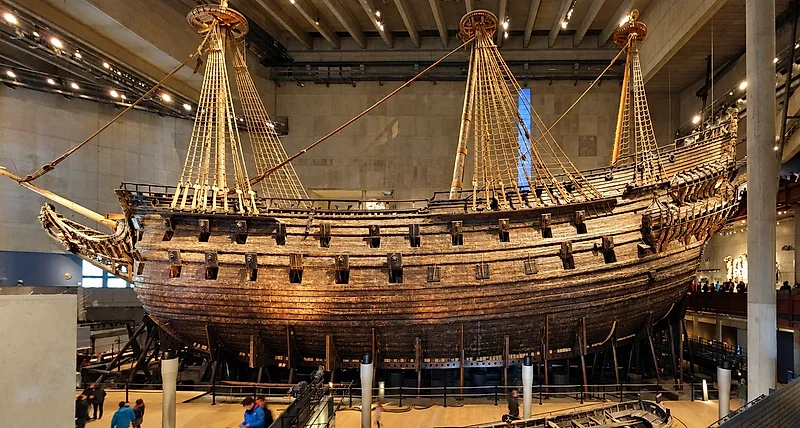
Inside the Vasa Museum (Vasamuseet) on Djurgården stands the warship Vasa itself: not a replica, but the ship that sank in Stockholm harbour in 1628. The museum calls it one of the world’s best preserved 17th-century ships, and Visit Stockholm notes that more than 98 percent of it is original.
THE SHIP, TO SCALE IN TIME
- 1626 · Building starts
The building of Vasa started in 1626 and was finished in 1628.
vasamuseet.se - 1628 · Sinks on her maiden voyage
Vasa sailed for only about 20 minutes before she started taking in water through the lower gunports and began to sink.
vasamuseet.se - 1956 · Found
Per Edvin Fälting and Sven Persson had confirmed on 4 September, 1956 that the small plugs of wood in Anders Franzén's corer came from a ship.
vasamuseet.se - 1961 · Raised
Even today, many still remember where they were when Vasa finally rose from the deep after 333 years in darkness.
vasamuseet.se - 1990 · The museum opens
King Carl XVI Gustaf inaugurated the museum on 15 June 1990
vasamuseet.se
- 69 mlong
When completed, it is 69 metres long and more than 50 metres tall from the keel to the top of the main mast.
vasamuseet.se - 64cannons
Vasa carried 64 cannons when she set off on her maiden voyage in August 1628
vasamuseet.se - 700+sculptures and decorations
There were over 700 sculptures and decorations on the ship.
vasamuseet.se - 98%+original
More than 98 percent of the ship is original
visitstockholm.com
The 1628 Maiden Voyage Disaster
King Gustav II Adolf ordered the ship, which was meant to be the most powerful warship in the Baltic, if not the world.
- The design flaw She was a little too tall and a little too narrow: the part below the waterline was too small for the part above it, which made her unstable.
- The sinking On 10 August 1628, 1,300 metres into her maiden voyage and still within sight of the shipyard where she was built, a gust of wind made her heel.
- The end Water poured in through the open lower gunports; she had sailed for only about 20 minutes.
Anders Franzén and the 1961 Salvage
In 1956 divers confirmed that the wood samples in Anders Franzén’s corer came from a ship. On 24 April 1961 the Vasa broke the surface after 333 years on the bottom of Stockholm harbour.
Conservation followed: polyethylene glycol (PEG) replaced the water in the wood, so that the timbers would not shrink and crack as they dried.
The Sculptures
The Vasa was a warship and a display window for Sweden and its king at the same time:
- Over 700 sculptures and decorations Lions, mermaids, angels, monsters and devils, and twenty Roman emperors along the beakhead.
- The figurehead A three-metre lion at the bow, holding the coat of arms of the Vasa dynasty.
- Once brightly painted Researchers have analysed about 1,200 microscopic paint fragments, and about fifteen key sculptures have been reconstructed to show how they were originally painted.
02 / THE STOCKHOLM GUIDE
How to Go Round the Museum
Start with the film, about 17 minutes, join the free guided tour of about 25 minutes, then walk the exhibitions on the floors around the ship. The ship stands in the middle of the hall. A good order for a first visit:
ALWAYS IN THE TICKET
Several things are always included in your ticket. vasamuseet.se
Start with the Film
The film tells how Vasa was built and sank on 10 August 1628, with news footage of the salvage, the excavation and the building of the museum. It is about 17 minutes long and is shown throughout the day in several languages.
Join the Free Guided Tour
Daily guided tours around the ship, in English and Swedish, take about 25 minutes and are included in the ticket; ask at the information desk for the day’s start times.
If no tour fits, the museum’s audio guide runs on your own phone over the free Wi-Fi. Bring your own headphones.
The Exhibitions Around the Ship
Around the ship, on the different floors, are in-depth exhibitions:
- Life on board Includes a full-scale replica of the upper gun deck and the helm that you can walk into.
- In Life and Death The people who died when Vasa sank. Researchers have re-examined the skeletons and now know, among other things, what they looked like and where they came from.
- And more Ships in battle, the sculptures, sailing ships, the salvage and the preservation of Vasa.
The 1:10 Model
A painted model at one-tenth scale shows how Vasa may have looked as she sailed out in 1628. It has stood in the ship hall since the museum opened in 1990 and carries over 500 sculptures of its own.
03 / THE STOCKHOLM GUIDE
Tickets, Bags and Getting There
You can always buy a ticket at the door or on the museum’s website (buying ahead gives no priority in the queue); under-19s go free, payment is by card only, there is no luggage storage, and tram 7 to Nordiska museet/Vasamuseet is the easiest way there.
Buying Tickets
Buy on the museum’s own website or at the door. The museum says you can always buy tickets on arrival, and that pre-purchased tickets do not give priority in the queue (Vasa Museum: hours and admission).
- Free for under-19s Children and teens up to 18 go free; children aged 12 and under must be with an adult.
- Adults Tickets cost more from May to September than in the rest of the year; both prices are in the table below.
- Cards only The museum is cash free.
- Fake ticket sites The museum asks visitors to buy through its official website or established vendors, so as not to be scammed.
TICKETS, FROM THE MUSEUM
| Ticket | May–September | January–April, October–December |
|---|---|---|
| Adults (including senior citizens) | SEK 240 | SEK 195 |
| Combo ticket with Vrak – Museum of Wrecks (valid 72 hours) | SEK 359 | SEK 315 |
18 years and under: Free admission
AT THE DOOR
Please note that pre-purchased tickets do not give priority in queue.
The Vasa Museum applies payment by card only. You can always buy tickets upon arrival.vasamuseet.se
BEFORE YOU QUEUE
There are no lockers or luggage storage at the museum.
Larger bags and wheeled bags are not allowed in the museum.
It can sometimes feel chilly inside the museum, so please bring a warm sweater.vasamuseet.se
Bags, Lockers and a Warm Layer
Three things catch visitors out at the door (Vasa Museum: plan your visit):
- No luggage storage There are no lockers or luggage storage at the museum.
- Bags Large bags and wheeled cases are not allowed; handbags and small rucksacks are, as long as you keep them with you.
- A warm layer To keep the ship preserved the hall is kept at 18–20°C, and the museum suggests a warm sweater.
Getting There
The museum is at Galärvarvsvägen 14 on Djurgården. Its own directions (Vasa Museum: getting here):
- Tram Tram 7 from the city centre to the stop Nordiska museet/Vasamuseet; the museum calls it the easiest way.
- Bus Bus 67 to the same stop.
- Ferry Line 82 from Slussen or line 80 from Nybroplan to Allmänna gränd, then about 8 minutes on foot.
- On foot About 30 minutes from the city centre.
04 / THE STOCKHOLM GUIDE
Combining It with Nordiska Museet and Skansen
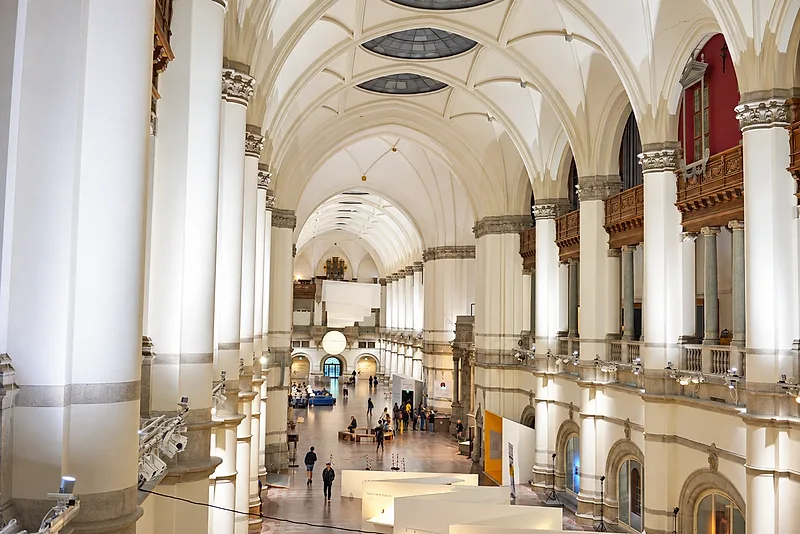
Nordiska museet, which shares the Vasa Museum’s tram and bus stop, and Skansen are the easy pairings on Djurgården; afterwards, walk back over Djurgårdsbron or take ferry 82 or 80.
Nordiska Museet and Skansen
Two neighbours make an easy pairing:
- Nordiska museet It shares its tram and bus stop, Nordiska museet/Vasamuseet, with the Vasa Museum.
- Skansen The open-air museum is also on Djurgården.
Back to the City Centre
Two ways back to the city centre:
- On foot Walk back over Djurgårdsbron to Strandvägen in Östermalm.
- By ferry Line 82 from Allmänna gränd to Slussen, or line 80 to Nybroplan.
A walking loop around DjurgårdenABBA The Museum, with opposite ticket rules
05 / THE STOCKHOLM GUIDE
Frequently Asked Questions About the Vasa Museum
How much time should I allocate for visiting the Vasa Museum?
The museum does not give a total. Its own guides are a measure: the film takes about 17 minutes, the guided tour about 25 and the audio guide about 40, and the exhibitions around the ship come on top.
Why is it chilly inside the museum?
The ship needs a temperature of 18–20°C to stay preserved, so the museum can feel chilly. The museum suggests bringing a warm sweater.
What is the easiest way to get to the museum from central Stockholm?
The museum calls tram 7 the easiest way, from the city centre to the stop Nordiska museet/Vasamuseet. Ferries 82 (from Slussen) and 80 (from Nybroplan) stop at Allmänna gränd, about 8 minutes’ walk away, and on foot it is about 30 minutes from the city centre.
Are there facilities for luggage, strollers, and dining on site?
There is no luggage storage: the museum has no lockers and does not allow large bags or wheeled cases inside. Strollers and prams are allowed in the museum but not in the restaurant, and there are lifts to every floor. The restaurant serves lunch and fika, and the shop, which you can visit without a museum ticket, sells ceramics, linen, metalwork and crafts inspired by Vasa and 17th-century Sweden.
BEFORE YOU GO
A flexible plan is a better plan.
Opening hours, admission policies, services and access can change. Check each attraction’s official website and the SL journey planner before travelling. Suggested times in this guide are planning estimates, not venue opening hours or guaranteed transfer times.
SOURCES
- Vasa Museum: hours and admissionvasamuseet.se
- Vasa Museum: plan your visitvasamuseet.se
- Vasa Museum: getting herevasamuseet.se
Last verified .
PHOTOGRAPHS & LICENCES1
- Wasa, Seitenansicht.jpg — Je-str · CC BY-SA 3.0, via Wikimedia Commons. Brightened and colour-adjusted for this page; cropped to fit. The edited version is shared under the same licence.