
01 / THE STOCKHOLM GUIDE
Can You See Stockholm in One Day?
Yes, if you keep to one corridor through the center and skip the outer districts.
When we only have 24 hours in Stockholm, every transfer must serve a purpose.
The Island Geometry Problem
The biggest mistake travelers make during a short Stockholm stopover is zig-zagging between disconnected districts. Jumping blindly from Södermalm to Djurgården and back to Norrmalm burns hours on transit platforms and bridge crossings.
- Water barriers dictate flow You cannot simply "walk in a straight line" between major hubs without hitting waterways.
- Elevation changes waste energy Neighborhoods like Södermalm sit on granite cliffs, while Gamla Stan sits at sea level.
- Transit backtracking kills momentum Every unnecessary transfer cuts into limited daylight hours.
ORDER BEFORE DISTANCE
THE TRAP
- Kungsholmen → Djurgården
- Djurgården → Södermalm
- Södermalm → Norrmalm
- Crossings
- 3
- Heads back west
- Yes
THE FIX
- Kungsholmen → Gamla Stan
- Gamla Stan → Djurgården
- Crossings
- 2
- Heads back west
- No
A route that runs from Kungsholmen out to Djurgården, back to Södermalm and up to Norrmalm spends much of the day crossing water. The fix is to keep moving forward: Kungsholmen, then Gamla Stan, then the ferry to Djurgården.
The Core-Focus Rule
To master Stockholm in one day, we apply the Core-Focus Rule: map a single, continuous west-to-east inner-city arc.
By anchoring the route along a natural waterfront corridor, walking becomes sightseeing rather than dead transit time. This strategy links the city’s political core, medieval center, and primary maritime museum into one seamless flow without turning back on your path.
What to Skip on a Single-Day Itinerary
Maximizing a tight Stockholm layover means knowing exactly what to leave behind:
- The Outer Archipelago
Excursions to Sandhamn or Vaxholm use up most of a day on the water. Stick to inner-harbor views.
- Drottningholm Palace
Located outside the city center, consuming at least half a day in transit and touring.
- Multi-Museum Marathons
Do not queue for multiple ticketed attractions. Pick one heavyweight museum and keep moving.
- Suburban Metro Art Tours
While the Stockholm subway art is world-class, riding peripheral lines drains daylight. View central hub stations like T-Centralen instead.
02 / THE STOCKHOLM GUIDE
The Route: West to East Through the Center
The route runs west to east along one walkable corridor, from Riddarfjärden and Gamla Stan by ferry to Djurgården, with short water and rail links in between.
Mapping the West-to-East Route
Our route starts at City Hall on the eastern tip of Kungsholmen, crosses the bridges into Gamla Stan with a detour onto the small island of Riddarholmen, cuts through the medieval core, crosses the harbor by public ferry to Djurgården, and returns along the northern waterfront.
THE ROUTE AT A GLANCE
Morning
- On foot
Morning
- On foot
Morning
- SL Commuter Ferry
Midday
- On foot
Afternoon
- Tram
Dusk
The order of the day and how each leg is travelled. Not to scale, and no times are implied.
This continuous geographic flow keeps you walking in one direction while covering the primary historical, cultural, and waterfront anchors.
Essential Transit: Stockholm Public Transport (SL)
Stockholm's integrated public transit system (SL) makes single-day transit effortless. You do not need dedicated tourist transit cards or paper tickets.
- Contactless Tap-to-Pay Tap a physical card, Apple Pay, or Google Pay at the metro gates and on the card readers for trams and ferries.
- Single Ticket Validity A single tapped fare is valid for 75 minutes across all modes—buses, metro (Tunnelbana), commuter trains, trams, and public ferries.
- Line 82 Ferry (Slussen to Djurgården) This regular commuter ferry doubles as a budget harbor tour and serves as our primary midday bridge across the water.
- Tram Line 7 (Spårväg City) Connects Djurgården with Nybroplan and continues toward T-Centralen.
Transit Leg
Midday Crossing
- Mode
- SL Commuter Ferry
- Route / Line
- Line 82 (Slussen → Allmänna Gränd)
- Payment Method
- Direct Contactless Tap
Transit Leg
Afternoon Return
- Mode
- Tram
- Route / Line
- Tram Line 7 (Djurgården → Nybroplan)
- Payment Method
- Direct Contactless Tap
Transit Leg
Optional Quick Jumps
- Mode
- Metro (Tunnelbana)
- Route / Line
- Red / Green Lines (Gamla Stan / T-Centralen)
- Payment Method
- Direct Contactless Tap
Timing and Pacing Blocks
When tackling Stockholm in one day, pacing is everything. We split the day into four distinct blocks to stay ahead of crowds and museum entry lines:
- Morning Block Outdoor sights first: Stockholm City Hall from the outside, the views from Riddarholmen, and the quieter early alleys of Gamla Stan.
- Midday Block The SL ferry crossing from Gamla Stan to Djurgården, with a quick waterfront lunch.
- Afternoon Block The Vasa Museum as the day’s one indoor anchor, followed by a walk along the Djurgården shoreline.
- Dusk Block The Djurgården tram back toward Strandvägen, or a sunset overlook on the Södermalm cliffs.
03 / THE STOCKHOLM GUIDE
Morning: City Hall, Riddarholmen and Gamla Stan
Start early at the City Hall courtyard by Lake Mälaren, cross to Riddarholmen, and walk into Gamla Stan for Stortorget, the Royal Palace and Prästgatan.
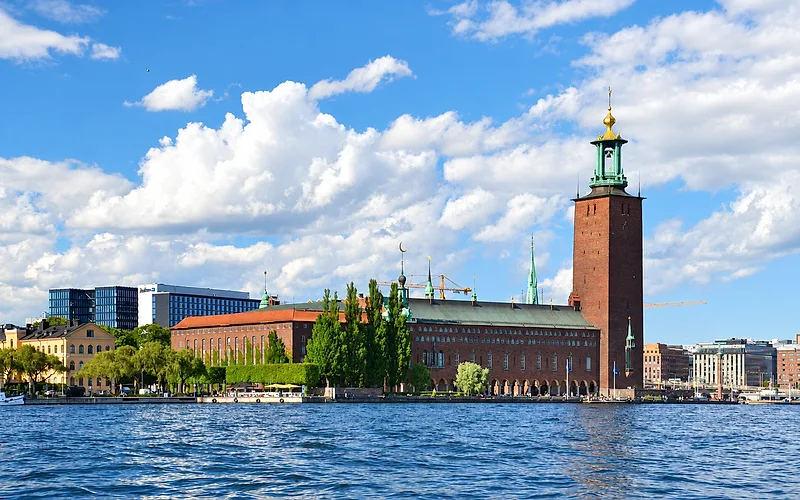
Lake Mälaren from the Stockholm City Hall Courtyard
Start at Stockholm City Hall on the edge of Lake Mälaren. You do not need to go inside for this stop: the building, its waterside park and the view are the point.
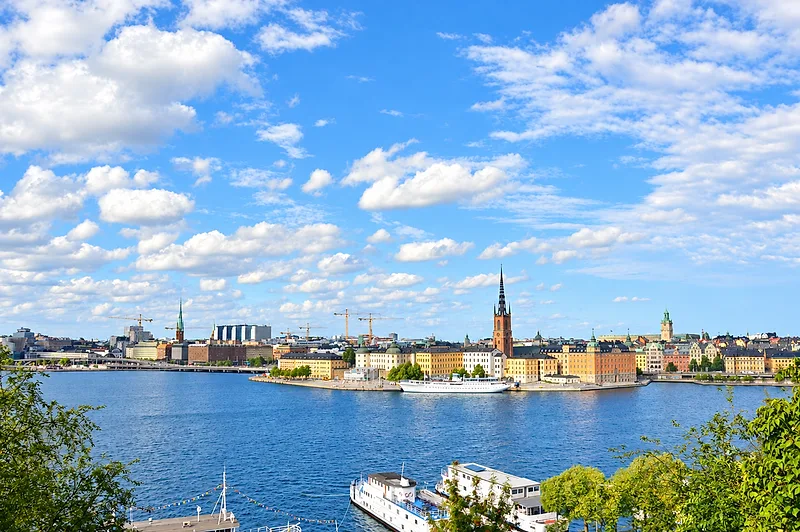
- Why start here From the stone colonnade and the waterside park you look across Lake Mälaren toward Södermalm and Riddarholmen.
- The visual map Looking across the water shows you the bridges you will cross next.
- Timing Keep this stop short. Take in the skyline, take your photos, and head for the bridges.
Riddarholmen Viewpoint and Quiet Bridges
From City Hall, cross Stadshusbron and follow the water to Vasabron, which leads over to Gamla Stan; from there Riddarholmsbron takes you onto Riddarholmen. This tiny islet holds centuries of royal history and remains far quieter than the central alleys nearby.
- Riddarholmen Church (Riddarholmskyrkan) Pass beneath the cast-iron openwork spire, the historic burial site of Swedish monarchs.
- Evert Taubes Terrass Walk to the western quay of the island for an unobstructed Riddarholmen viewpoint looking back at the City Hall tower across the water.
- Cobblestone transition Cross the small connecting bridge straight into the medieval street network of Gamla Stan.
Gamla Stan Medieval Alleys: Stortorget, Royal Palace, and Prästgatan
Once inside the old town, skip the tourist-heavy shopping strip of Västerlånggatan and use this focused Gamla Stan walking route:
Landmark · Route Action
south
PrästgatanWalk south along this quiet backstreet
Key FocusPreserved medieval cobblestones, away from the souvenir shops.
east
StortorgetCut east into the central square
Key FocusThe colourful merchant houses and the Nobel Prize Museum facade.
north
Royal Palace (Kungliga Slottet)Head north to the palace courtyards
Key FocusWalk through the outer courtyard (Yttre Borggården) for massive Baroque architecture.
Directions as the guide gives them. The dial shows a bearing, not a distance.
Keep moving at a steady pace. Experiencing the exterior architecture and alley layout gives you the true medieval context without getting bogged down in ticket lines. Once you have seen the palace courtyards, steer toward the eastern quayside along Skeppsbron and on to the ferry at Slussen.
Spend longer in the old town’s side streetsGoing inside the City Hall instead of past it
04 / THE STOCKHOLM GUIDE
Midday: The Ferry from Slussen to Djurgården
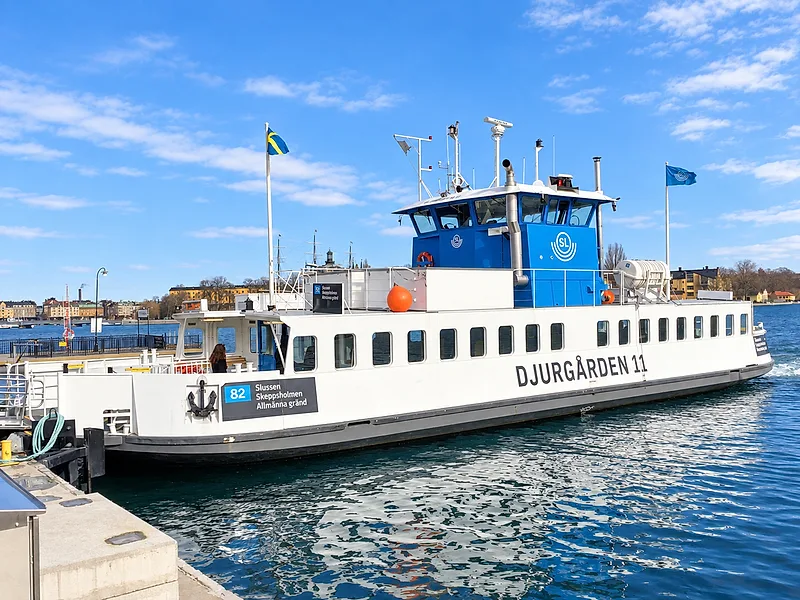
Take the SL public ferry from Slussen (Skeppsbron) to Djurgården instead of changing metro lines; you see the skyline from the water on the way.
Boarding the SL Public Ferry at Slussen (Skeppsbron)
To leave the old town, walk down to the Slussen / Skeppsbron ferry quay on the eastern edge of Gamla Stan.
Ferry Route Detail
Key Information
Line Take SL Ferry Line 82 (Djurgårdsfärjan).
Payment MethodContactless card / SL App / SL Card
- Payment Tap your contactless bank card or phone on the card reader. The ferry is an ordinary SL journey, covered by a regular SL ticket.
- Timetable Departures vary through the day and by season, so check the SL journey planner before you walk down.
Harbor-Level Skyline Views from a Public Ferry
Sightseeing boats are one way to see the harbor. The regular public ferry gives you water-level views of the historic waterfront on an ordinary SL ticket.
- Railside views Where there is room, stand by the railing for clear views of Gamla Stan’s golden façades and the naval buildings of Skeppsholmen.
- Efficient Route The boat tracks a clean arc across the open water, letting you photograph the city's maritime core without burning daylight.
Direct Arrival at Djurgården’s Museum Corridor
The ferry docks at Allmänna gränd on Djurgården. Stepping off the boat puts you on Stockholm’s park and museum island, a short walk from the Vasa Museum and open green spaces.
05 / THE STOCKHOLM GUIDE
Afternoon: The Vasa Museum and a Djurgården Walk
On Djurgården, see the Vasa Museum, then walk the waterfront paths.

Inside the Vasa Museum: Seeing the Warship Efficiently
The Vasa is one of the world’s best preserved 17th-century ships, raised 333 years after it sank in Stockholm harbor on its maiden voyage in 1628. To keep it preserved, the hall is kept at 18–20°C.
We avoid getting bogged down in full-length audio tracks. Instead, we use the museum’s vertical layout to take in the ship from multiple elevations:
SEE IT FROM THREE HEIGHTS
- Start at ground level
The 1:10 scale model and the lion figurehead are here, and the model shows how the ship looked before it sank.
- Climb for the stern
Higher up, the richly carved sterncastle comes into full view.
- Look from the top
The top floor gives an overview of the whole ship.
Heights are relative, drawn on a simple outline of the hull. Floor numbers are left out on purpose; follow the museum’s signs.
Keeping the Vasa Visit Focused
To keep a one-day itinerary moving, treat the Vasa Museum as the day’s single long stop and decide before you go in how much of the afternoon it gets.
Tickets You can buy them online or when you arrive. Buying ahead does not get you past the entrance queue.
- Targeted exhibit navigation Pick two or three exhibitions that interest you, such as Life on Board, rather than trying to cover every floor.
Djurgården Waterfront Walk: Coastal Promenades
Stepping out of the climate-controlled museum hall into the daylight resets our energy. Djurgården was historically royal hunting land, now maintained as a public park with paved paths hugging the shoreline.
- Start at Galärvarvet
Walk down to the waterfront beside the museum, where museum ships, among them a lightship and an icebreaker, are moored along the quay.
- Follow the water toward Djurgårdsbron
The shoreline gives open views across the water to the stone facades of Strandvägen.
- Keep the pace steady
The bridge is close by, so this walk fits in without eating into the late afternoon.
Weigh the Vasa against its museum neighboursWalk the rest of DjurgårdenTickets, bags and what to see at the Vasa Museum
06 / THE STOCKHOLM GUIDE
Late Afternoon: Strandvägen or the Södermalm Cliffs
End the day one of two ways: take the Djurgården tram and walk Strandvägen, or go to the Monteliusvägen cliffs on Södermalm for the sunset.

Option A · Strandvägen
Option A (Harbor Walk): Djurgården Tram and Strandvägen Promenade
If your feet are tired, this is the lowest-friction option:
- Catch Tram Line 7
- Board at the Djurgårdsbron or Nordiska museet/Vasamuseet stop and ride back toward the city center.
- Stroll Strandvägen
- Or walk across the bridge and along the grand Strandvägen promenade, with 19th-century stone mansions on one side and historic boats moored on the other.
- The Atmosphere
- Sophisticated, bustling, and flat. It leads you to Nybroplan without any climbing.
- Best Suited For
- Tired legs, chilly weather, classic streetscapes
- Physical Effort
- Low (Flat stroll / Tram 7)
- Transit Link
- Direct to Nybroviken
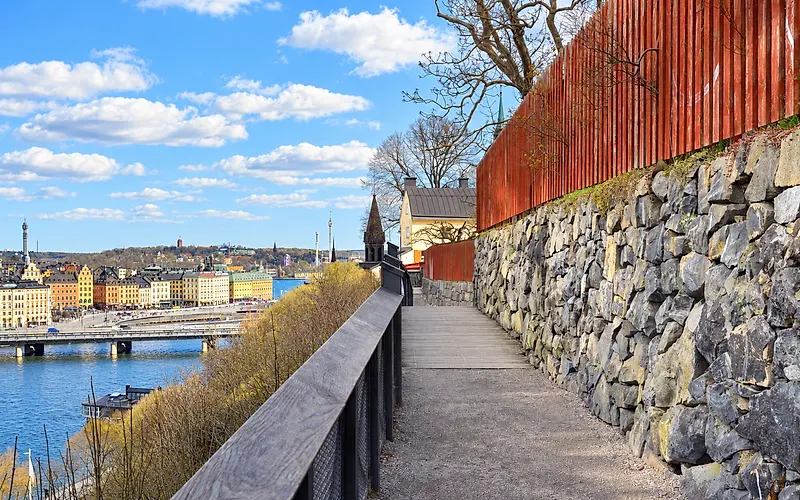
Option B · Monteliusvägen
Option B (Sunset Heights): Monteliusvägen Cliffs on Södermalm
If you want the best skyline view in the city and have the energy for a climb:
- Head to Södermalm
- Take the line 82 ferry from Djurgården back to Slussen, then walk up the hill into northern Södermalm.
- Walk Monteliusvägen
- Follow the cliffside path, part gravel and part boardwalk, along the ridge.
- The Atmosphere
- Dramatic and open. You get a panoramic view over Lake Mälaren, Riddarholmen, and Stockholm City Hall in the late daylight.
- Best Suited For
- Golden-hour photography, clear skies, panoramic views
- Physical Effort
- Medium (uphill walk)
- Transit Link
- Slussen / Mariatorget Metro
Route ChoiceTwo ways to finish the day. Pick one.
Where Each Option Ends
Option A ends at Nybroviken, on the edge of the modern downtown, with places to eat nearby and easy connections back toward Central Station. Option B ends on Södermalm, where Slussen and Mariatorget metro stations take you back into the city.
07 / THE STOCKHOLM GUIDE
Running Late? What to Cut
If the day slips, cut the detours rather than rushing: below is what to drop if you fall behind by midday, if it turns cold or wet, and if you have a flight or ship to catch.
Here is how we adapt our route on the fly:
WHEN THE DAY SLIPS
Morning
City Hall
- On foot
Morning
Riddarholmen
- On foot
Morning
Gamla Stan
- SL Commuter Ferry
Midday
Djurgården
- On foot
Afternoon
Vasa Museum (cut)
- Tram
Dusk
Strandvägenor Monteliusvägen
- What to Cut
- Vasa Museum indoor queues & secondary galleries
- What to Keep
- Gamla Stan + Public Ferry
- Immediate Action
- Walk Djurgården's outer edge; do not enter crowded ticket lines.
- What to Cut
- Monteliusvägen cliffs & exposed bridge walks
- What to Keep
- Vasa Museum + tram and metro rides
- Immediate Action
- Ride Tram 7 to Djurgården and spend the time inside the Vasa Museum.
- What to Cut
- Djurgården parks & City Hall courtyard
- What to Keep
- Gamla Stan medieval core + Ferry ride
- Immediate Action
- Stick strictly to the Slussen–Gamla Stan corridor near central transit.
Struck-through stops are the ones this case’s “What to Cut” names. Everything else on the line stays.
Scenario A: Falling Behind by Midday
If it is already well past midday when you cross to Djurgården, cut the large indoor exhibits. A thorough visit to the Vasa Museum or the museums next to it takes up a large part of the afternoon.
Instead, we pivot to an entirely scenic outdoor loop: take in the historic shipyard quays from outside, follow the waterfront path around Djurgården, and take the public ferry back to Slussen to regain lost time.
Scenario B: Cold Snaps or Rain
Stockholm's Baltic winds can turn waterfront promenades brutal, especially between October and April. If the weather turns, we drop open-air ridge walks like Monteliusvägen and long bridge treks across Lake Mälaren.
- Use Stockholm inner city transit Rely on Tram 7 and the heated T-Bana rather than walking long boulevard stretches.
- Shift indoors Swap open street wandering for more time inside the Vasa Museum or a warm sit-down lunch indoors.
Scenario C: Tight Flight or Cruise Layovers
For a high-stakes Stockholm layover with only half a day or so on the ground, we strip the route down to its non-negotiable anchors:
- Gamla Stan Core A short loop through Stortorget and Prästgatan.
- The Water Crossing The short SL ferry ride between Slussen and Djurgården for the skyline view.
- Direct Return Straight back to Stockholm Central Station (T-Centralen) for the Arlanda Express or your port transfer.
08 / THE STOCKHOLM GUIDE
Shoes, Payment and Daylight
Wear shoes with grip for the cobblestones, bring a contactless card, charge your phone, and plan around the season’s daylight.
Granite and Cobblestone Realities: Choosing Footwear
A self-guided walk across the inner-city arc adds up to a lot of steps.
- The Terrain Gamla Stan, Riddarholmen, and Södermalm feature uneven cobblestones, steep inclines, and slick granite curb cuts.
- Footwear Choice Leave thin canvas sneakers and dress shoes in your luggage. We rely on broken-in running shoes, trail runners, or supportive low-profile boots with deep rubber tread.
- Wet Weather Grip Historic stone pathways become exceptionally slick during rain or light snow; traction is essential to maintain a rapid walking pace.
Bring a Contactless Card
Visit Stockholm describes the city as “in large parts a cash-free city”, so bring a card.
- Contactless is Standard Digital wallets (Apple Pay, Google Pay) and tap-to-pay cards work for SL journeys and at most counters, from ticket desks to bakeries.
- Card Preparation Ensure your card has no foreign transaction fees and has contactless functionality enabled before arriving.
Seasonal Daylight Factors: Summer vs. Winter Strategy
Daylight variability dictates how we structure 24 hours in Stockholm. Because Nordic light levels swing drastically between solstices, matching the clock to the sun is critical.
- Summer The days are very long, so the waterfront route can run late into the evening.
- Spring and autumn Follow the standard west-to-east arc with a balance of indoor and outdoor time.
- Winter Daylight is short. Put the viewpoints (City Hall, Gamla Stan, Monteliusvägen) early in the day and keep the Vasa Museum for when it gets dark.
09 / THE STOCKHOLM GUIDE
Frequently Asked Questions About Stockholm in One Day
Is one day really enough to experience Stockholm?
Yes, provided you stick to a continuous central line rather than bouncing randomly between outer islands. A single day in Stockholm gives you plenty of time to cover the core historical and maritime sights: walking the medieval streets of Gamla Stan, riding the Stockholm public ferry across the harbor, and touring the Vasa Museum.
While 24 hours in Stockholm will not allow for side trips into the outer archipelago or visits to distant royal estates like Drottningholm, an organized west-to-east inner-city route delivers a complete, high-impact view of the capital without feeling chaotic.
What You Can Fit in One Day
- Gamla Stan & Riddarholmen walking route
- Vasa Museum as the one long stop
- SL Commuter Ferry harbor crossing
- Strandvägen waterfront or Monteliusvägen sunset
What You Should Save for a Longer Trip
- Outer Stockholm Archipelago day cruises
- Drottningholm & Skokloster Palaces
- In-depth art museum crawls (Moderna Museet, Nationalmuseum)
- Full-day exploration of outer residential neighborhoods
What is the fastest transit option from Arlanda Airport to central Stockholm?
If you are on a tight Stockholm layover, the Arlanda Express train is the most efficient choice.
- Arlanda Express A dedicated airport train that runs non-stop to Stockholm Central Station.
- SL Commuter Train (Pendeltåg Line 40) Stops at Arlanda C and continues to Stockholm City station. An extra airport passage fee applies on top of a regular SL ticket.
- Flygbussarna Airport Coaches The coaches run into the city by road, so traffic makes journey times harder to predict on a strict one-day schedule.
Where can I stop for a quick traditional Swedish fika along this route?
A proper fika—coffee paired with a fresh cinnamon or cardamom bun (kanelbulle or kardemummabulle)—fits naturally into the mid-morning or mid-afternoon transitions along this route:
- In Gamla Stan The old town has plenty of cafés; step off the main shopping street for a quieter table.
- Near the Vasa Museum Djurgården has cafés close to the museums, handy before or after your visit.
- Along Strandvägen Pick up takeaway coffee and buns from waterfront bakeries near Nybroviken to enjoy directly on the harbor promenade benches.
10 / FURTHER READING
Related Sources
BEFORE YOU GO
A flexible plan is a better plan.
Opening hours, admission policies, services and access can change. Check each attraction’s official website and the SL journey planner before travelling. Suggested times in this guide are planning estimates, not venue opening hours or guaranteed transfer times.
Last verified .
PHOTOGRAPHS & LICENCES4
- At Stockholm 2019 042.jpg — Photograph by Mike Peel (www.mikepeel.net). · CC BY-SA 4.0, via Wikimedia Commons. Brightened and colour-adjusted for this page; cropped to fit. The edited version is shared under the same licence.
- Stockholm City Hall (by Pudelek).JPG — Pudelek · CC BY-SA 4.0, via Wikimedia Commons. Brightened and colour-adjusted for this page; cropped to fit. The edited version is shared under the same licence.
- Djurgarden 11 - Boghammar marin 1998.jpg — Sinikka Halme · CC BY-SA 4.0, via Wikimedia Commons. Brightened and colour-adjusted for this page; cropped to fit. The edited version is shared under the same licence.
- Wasa, Seitenansicht.jpg — Je-str · CC BY-SA 3.0, via Wikimedia Commons. Brightened and colour-adjusted for this page; cropped to fit. The edited version is shared under the same licence.