Stockholm is hiding a world-class art gallery right beneath your feet.
With over 90 stations transformed into vibrant, rock-carved masterworks, exploring the iconic Stockholm metro art is an absolute must. But across 110 kilometers of tracks, which stops are actually worth your time?
In this guide, you’ll discover the most breathtaking stations, the exact lines to ride, and insider tips to experience the world’s longest art exhibition effortlessly.
Let's head underground!
01 / THE STOCKHOLM GUIDE
Planning the Route on One Ticket
Group stations by metro line and use T-Centralen as your interchange. A standard SL single ticket covers journeys and transfers within its 75-minute window; allow extra time or use an appropriate travelcard for a longer art visit.
FIVE ART STOPS · TWO LINES
Choose a station to jump to its art and photography guide.
Schematic art-stop map, not a full transit map. Intermediate stations are omitted. Check destination signs and current services with SL; ticket validity is time-based.
The Single-Ticket Routing Logic
To get the most out of your fare, plan a continuous underground loop through central Stockholm:
- Watch the clock, not the gatesa single ticket runs for 75 minutes from the first tap, and leaving and re-entering within that window costs nothing extra.
- Prioritize Central Transfer Hubs Focus your initial path around major connection points like T-Centralen, where the Blue and Red lines intersect directly.
- Target High-Density Sectors Group stations by line to minimize train wait times and avoid unnecessary backtracking.
Phase 1 · Blue Line (Deep Level)
Key Stations Covered
- Kungsträdgården
- T-Centralen
- Rådhuset
Transfer ActionSeamless platform hop
Phase 2 · Red Line (Upper Level)
Key Stations Covered
- Stadion
- Tekniska Högskolan
Transfer ActionIn-station central transfer
Pacing and Duration for a Self-Guided Tour
While a single 75-minute window is sufficient for a targeted three-station sprint, treating the network as an architectural exhibition works best as a relaxed 2 to 3-hour half-day itinerary.
PLATFORM TIME AGAINST ONE TICKET
8 min per stationup to 12 min per station75-minute ticket
Platform time and one 5-minute transfer only. Train waits and the rides themselves are extra, which is why a longer route is better treated as an unhurried visit than a single-ticket sprint.
- Platform Dwell Time Budget 8 to 12 minutes per station. This provides adequate time to step off the train, walk both ends of the platform vault, photograph the cave textures, and board the next arriving train.
- Transfer Buffers Allow 5 minutes at interchange hubs to navigate the escalators connecting deep bedrock lines to upper tracks.
Crowd Timing and Platform Flow
Timing determines whether you photograph clean cavern vistas or crowded transit commutes.
Mid-Morning: 09:30 – 11:30 (Post-morning rush hour)Mid-Afternoon: 13:30 – 15:30 (Prior to evening school and office dismissals)
- Optimal Photography Windows
- Late Evening After 20:00 on weekdays for near-empty platforms
- Managing the Train Clearance Wave When a train departs, wait 45 to 60 seconds. The departing passenger surge clears the platform quickly, leaving an unobstructed cavern view before the next inbound train arrives.
02 / THE STOCKHOLM GUIDE
Leg 1: The Blue Line Cave Stations
Leg 1 covers three Blue Line stations, T-Centralen, Rådhuset and Kungsträdgården, where the rock was sprayed with concrete rather than tiled, so the shapes of the caves remain.
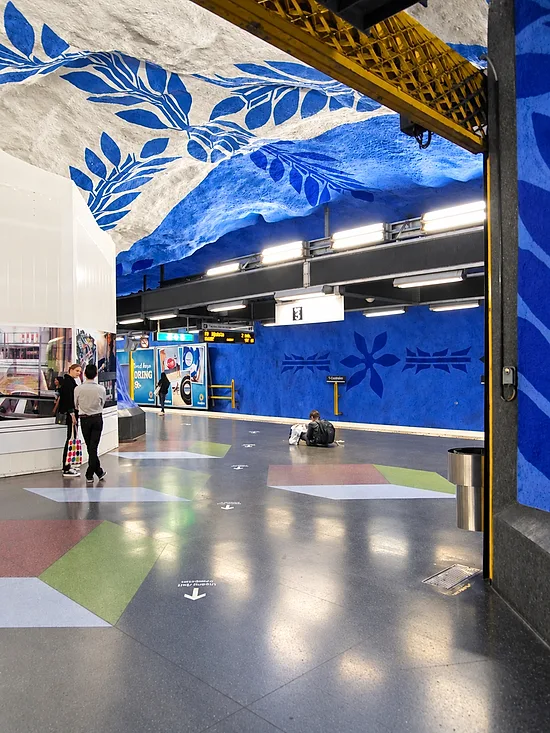
DEEP BEDROCK CAVERN
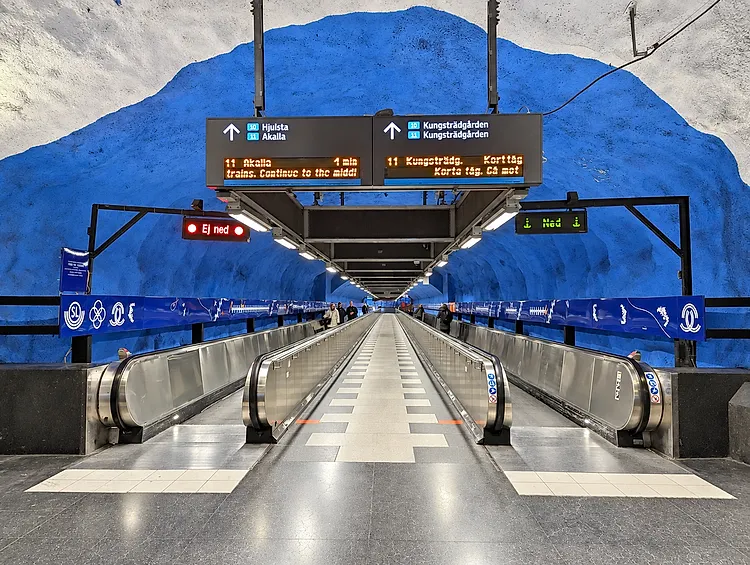
T-Centralen: The Blue Platform Sanctuary
Deep below the central interchange, at the Blue Line platforms, the atmosphere shifts completely away from the transit hub above.
- Visual Highlights
- Massive white cavern arches covered in stylized blue vine motifs and silhouettes honoring the construction workers who carved out the system.
- Lighting Balance
- Cool white fluorescent fixtures contrast against the rich cobalt brushwork on exposed stone.
- Composition
- photograph the blue ceiling arches from a safe public platform area. Stay behind the platform safety line and keep passenger routes clear.
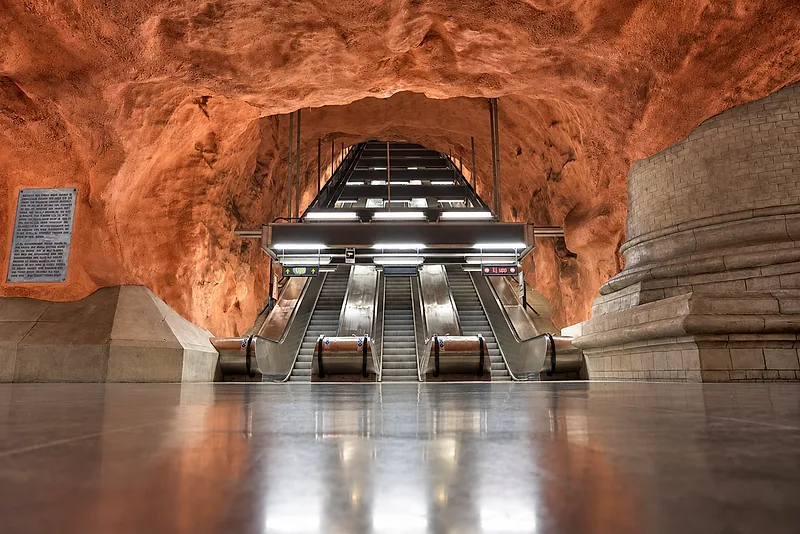
PINK ROCK FACE
Rådhuset: Industrial Cavern and Escalator Perspectives
Rådhuset metro station sits directly underneath the Court House, evoking a subterranean archeological dig.
- Monolithic Palette
- The rock is painted pink throughout; the artist, Sigvard Olsson, matched it to the colour found deep inside the Atlas Mountains.
- Key Features
- Giant industrial foundations and chimney bases integrate directly into the raw rock formations.
- Framing Technique
- Shoot from the base of the long escalator bank looking up toward the cavern ceiling; the mechanical metal tracks set against organic reddish stone deliver an immediate sense of scale.
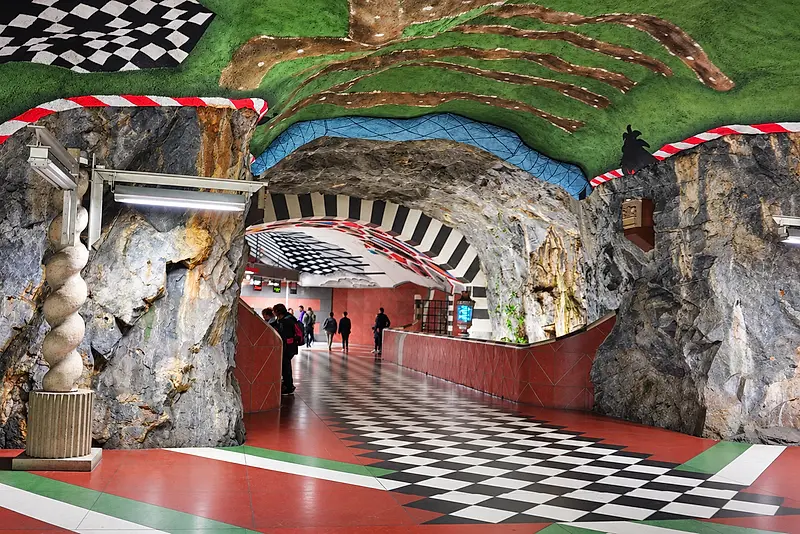
03 / THE STOCKHOLM GUIDE
Changing from the Blue Line to the Red Line
Change lines at T-Centralen: it is the metro’s central interchange, and you switch without leaving the ticket gates or tapping your ticket again.
Navigating Between Deep Caverns and Upper Tracks
T-Centralen is built across multiple vertical levels. The Blue Line platforms sit deep inside the bedrock, while the Red and Green Lines occupy upper platforms.
ONE STATION, SEVERAL LEVELS
3. Platform Access
Upper Red Line LevelTake the connecting stairs or short escalator up to the northbound Red Line platform and take a line 14 train toward Mörby centrum to continue your route to Stadion and Tekniska Högskolan.
2. Intermediate Concourse
Mid-Level MezzanineFollow the direct overhead signage toward Line 14 (Röda linjen).
1. Ascent
Blue Line platformsTake the long central escalator bank up from the blue-and-white bedrock vault.
Moving between the lower bedrock vault and the upper platforms takes approximately three to four minutes at a standard walking pace.
Seamless Platform Transfer at T-Centralen
Changing lines at T-Centralen needs no second tap, and the 75-minute window keeps running either way, so follow these transfer rules:
- Stay on the transfer levelfollow the platform-to-platform signs rather than the street exits (Central Station/Vasagatan).
- Follow Color-Coded Overhead Signs Look for the red line markers pointing toward northbound line 14 trains (Mörby centrum; line 13 toward Ropsten does not stop at Stadion or Tekniska Högskolan).
- One fare, two linesthe Blue Line caverns and the Red Line station art can sit inside the same 75-minute window if you keep an eye on the time you have left.
04 / THE STOCKHOLM GUIDE
Leg 2: Stadion and Tekniska Högskolan on the Red Line
Leg 2 takes you to two Red Line stations, Stadion with its rainbow arch and Tekniska högskolan with its science motifs, where the art is graphic and conceptual rather than cave-like.
Red Line Art Station
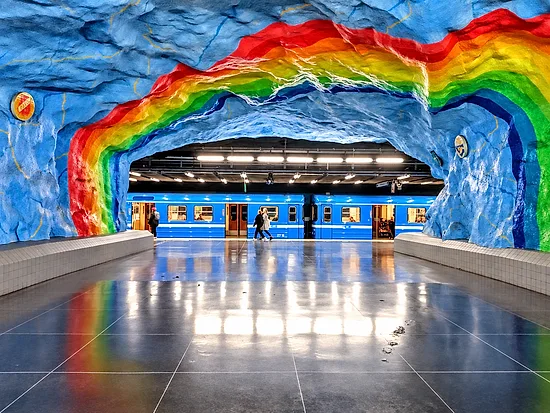
SKY-BLUE BEDROCK
Stadion: Sky-Blue Bedrock and the Vibrant Rainbow Arch
Stadion station breaks away from deep underground darkness with bright, sky-blue painted bedrock walls and its iconic painted rainbow arch spanning across the central cave vault.
- Primary Visual Highlight
- Massive center-vault rainbow arch
- Optimal Framing Point
- Center platform alignment facing west
- Artistic Focus Created by Enno Hallek and Åke Pallarp around the theme of the Stockholm Olympic Stadium nearby, built for the 1912 Games, with the 1912 Olympic poster among its motifs and the rainbow across the vault.
- Photography Setup Position yourself dead-center along the central platform divide. Use an ultra-wide lens to frame the full sweep of the rainbow arch as it bridges the two platform tracks.
- Lighting Dynamic The bright blue rock finish bounces ambient light cleanly, reducing motion blur and allowing crisp handheld shots without high ISO noise.
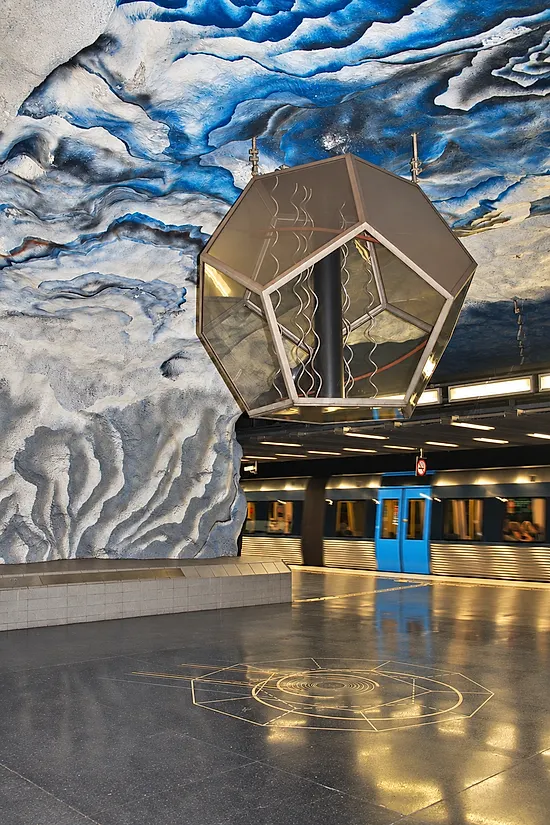
COSMIC GEOMETRY
Tekniska Högskolan: Cosmic Motifs and Elemental Spheres
Tekniska Högskolan serves the Royal Institute of Technology (KTH) and mirrors its academic surroundings with installations celebrating the laws of nature, mechanics, and the universe.
- Primary Visual Highlight
- Suspended dodecahedron & Platonic solids
- Optimal Framing Point
- Low-angle shot directly beneath the central ceiling vault
- Artistic Highlights Artist Lennart Mörk designed the station around the classical elements—earth, water, air, and fire—alongside pivotal scientific advances.
- Key Visuals A large dodecahedron hangs from the cavern ceiling, one of the five Platonic solids that stand for the classical elements, alongside Newton’s apple, the wings of Icarus and quotations from the history of science.
- Composition Guide Stand underneath the suspended geometric polyhedra and frame upward against the textured, charcoal-toned ceiling to capture the contrast between rough bedrock and precise mathematical forms.
05 / THE STOCKHOLM GUIDE
Photographing the Stations, and Metro Etiquette
Use an ultra-wide lens, adjust for the mixed lighting, and keep out of commuters’ way on the platforms.
Stockholm Metro Photography: Managing Mixed Lighting
Tunnelbana stations feature a notoriously high-contrast lighting environment. Deep cavern bedrock glows with rich, saturated pigment under directional spotlights, while track edges and boarding areas use harsh, cool fluorescent fixtures.
WARM CAVERNS, COOL PLATFORMS
ISO 800–1600f/2.8–f/4Shoot RAW3-shot bracket
| Lighting Scenario | Challenge | Recommended Setting / Technique |
|---|---|---|
| Monolithic Caverns (Rådhuset) | ChallengeHeavy orange/red cast, deep shadow pockets | Recommended Setting / TechniqueAuto WB with warm bias (-0.3 EV), ISO 800–1600 |
| Fluorescent Tracks (T-Centralen) | ChallengeHarsh cool overheads, strong highlight burn | Recommended Setting / TechniqueExposure locked on painted ceiling, f/2.8–f/4 |
| Escalator Shafts | ChallengeExtreme dynamic range from entry to base | Recommended Setting / Technique3-shot HDR bracket or smartphone Night Mode |
Settings quoted from the guide. Lighting varies by station and time of day — treat them as starting points.
- Shoot in RAW or ProRAW High dynamic range is vital to recover shadowed rock textures without blowing out fluorescent light strips.
- Balance White Balance Manually Set your Kelvin temperature around 4000K–4500K to prevent red and orange cavern stations from appearing overly muddy or unnaturally shifted.
- Bracket High-Contrast Compositions When framing deep escalator tunnels leading into glowing platforms, capture three-shot exposures (-1, 0, +1 EV) to retain ceiling texture and shadow detail.
- Handheld Smartphone Tip Tap to focus on the mid-tone bedrock rather than direct lights, and dial the exposure slider slightly down to preserve deep color saturation.
Lens Selection: Why Ultra-Wide Glass Is Essential
The sculpted bedrock ceilings demand an expansive field of view that standard lenses simply cannot capture within tight platform boundaries.
HOW WIDE IS WIDE ENOUGH
Ranges named in the guide, plotted on a 35mm-equivalent scale.
- Focal Length Range A 16–24mm equivalent ultra-wide lens is the single best tool for this route. It fits soaring cave arches, towering structural pillars, and platform floors into a single frame without distortion-induced edge softness.
- Smartphone Equivalents Use the dedicated 0.5x ultra-wide lens module. Step back against platform structural walls to frame complete archways and symmetry lines.
- Prime vs. Zoom A wide zoom (such as a 14–24mm or 16–35mm f/2.8) provides the framing flexibility needed when train arrivals or structural barriers limit physical movement.
Commuter Flow and Safety Considerations
Preserving accessibility and personal safety takes priority over any shot composition. Stockholm’s metro is an active transit system moving hundreds of thousands of daily commuters.
06 / THE STOCKHOLM GUIDE
Frequently Asked Questions About Stockholm Metro Art
How much does a Stockholm metro ticket cost for an art tour?
A single ticket runs for 75 minutes from the first tap; check current SL fares before you travel.
A standard single ticket is valid for 75 minutes. For a longer visit, compare a travelcard with your planned journeys. See current SL fares; no fare amount is fixed in this guide.
- Payment Method Tap your contactless credit card, debit card, or smartphone directly at the turnstile barrier.
- Validity windowa single ticket covers journeys and transfers for 75 minutes from the first tap. See SL’s single-ticket rules.
- Extended optionsa 24-hour travelcard may suit an unhurried photography visit. Compare current SL fares and validity conditions before buying.
Can you see the top subway art stations on a single 75-minute ticket?
A short loop of a few stations fits comfortably; the full route is better treated as an unhurried visit.
Within 75 minutes of the first tap, yes. The window is the limit, not the barriers, and stepping out and back in during it is allowed.
- A short loopchoose a few nearby stations and check the remaining ticket time. Train waits and photo stops vary, so the full five-station route is not guaranteed to fit into one single-ticket window.
- Extended Exploration If you want to linger for clean shots without rushing between train arrivals, buy a 24-hour pass to explore the network at your own pace.
Is a self-guided metro tour better than an organized group tour?
Self-guided suits photography — you set the pace and the stations.
A self-guided route offers distinct operational advantages over structured commercial tours:
- Flexible timingallow room for photo stops and keep your ticket valid for the journeys you make.
- Cost Efficiency You only pay the standard public transit fare rather than inflated tour guide premiums.
- Custom Route Focus strictly on the specific aesthetics you want to see—from raw bedrock caverns to geometric installations—without adhering to a fixed group schedule.
Are tripods and professional camera gear allowed inside Tunnelbana stations?
Handheld cameras and phones are fine; large tripods block the platform.
Handheld cameras, gimbals, and smartphones are fully permitted for personal photography throughout all Tunnelbana art stations.
- Tripods Using large tripods or light stands during regular hours can block passenger flow and may prompt station staff or security to intervene.
- Best Practice Rely on wide-aperture lenses and built-in image stabilization for handheld shooting. If you must use a tripod, keep the footprint minimal and shoot late at night when foot traffic is negligible.
What is the best time of day to photograph Stockholm subway stations without crowds?
Mid-morning, mid-afternoon and late evening are the windows the guide names.
Platform traffic dictates how quickly you can capture clean, wide-angle architectural views of the bedrock caves. Treat the windows below as this guide’s own estimate; crowds vary by day, station and season.
WHEN THE PLATFORMS ARE CLEAR
Named as a good windowNamed as a commuter peakNot specified in the guide
| Time Window | Crowd Level | Photography Suitability |
|---|---|---|
| 07:00 – 09:00 | Crowd LevelPeak Commute | Photography SuitabilityPoor (Heavy foot traffic and full platforms) |
| 10:00 – 14:30 | Crowd LevelLow to Moderate | Photography SuitabilityOptimal (Steady train frequency with quiet intervals) |
| 16:00 – 18:30 | Crowd LevelPeak Commute | Photography SuitabilityPoor (Obstructed sightlines at central hubs) |
| 20:30 – 23:30 | Crowd LevelMinimal | Photography SuitabilityOptimal (Long quiet gaps between train arrivals) |
| Weekend Mornings (Before 09:30) | Crowd LevelVery Low | Photography SuitabilityOptimal (Empty platforms and minimal commuter movement) |
Only the windows the guide states are drawn, in its own words for each one. Anything it leaves unscheduled stays blank.
BEFORE YOU GO
A flexible plan is a better plan.
Opening hours, admission policies, services and access can change. Check each attraction’s official website and the SL journey planner before travelling. Suggested times in this guide are planning estimates, not venue opening hours or guaranteed transfer times.
SOURCES
- current SL faressl.se
- SL’s single-ticket rulessl.se
Last verified .
PHOTOGRAPHS & LICENCES6
- Blåa linjen, rullband, T-Centralen, 20230226.jpg — AleWi · CC BY-SA 4.0, via Wikimedia Commons. Brightened and colour-adjusted for this page; cropped to fit. The edited version is shared under the same licence.
- Stockholm - Tunnelbana - T-Centralen (11106338194).jpg — Ingolf from Berlin , Deutschland · CC BY-SA 2.0, via Wikimedia Commons. Brightened and colour-adjusted for this page; cropped to fit. The edited version is shared under the same licence.
- Rådhuset (31176711988).jpg — Tom Björkstedt · CC BY 2.0, via Wikimedia Commons. Brightened and colour-adjusted for this page; cropped to fit.
- 20180623 Stockholm 6386 (48410972942).jpg — Ray Swi-hymn from Sijhih-Taipei, Taiwan · CC BY-SA 2.0, via Wikimedia Commons. Brightened and colour-adjusted for this page; cropped to fit. The edited version is shared under the same licence.
- C6 Stadion.jpg — Anton Lidström · CC BY-SA 4.0, via Wikimedia Commons. Brightened and colour-adjusted for this page; cropped to fit. The edited version is shared under the same licence.
- Tekniska högskolan - august 2016 - 5.jpg — AleWi · CC0, via Wikimedia Commons. Brightened and colour-adjusted for this page; cropped to fit.